
Quantum Superposition#
Superposition is exactly what was discussed before. It’s the ability of a quantum bit to be in both the 0 and 1 state at the same time.
However, here’s a strange detail… A qubit can only be in superposition once we’ve not looked at it!
Schrödinger’s cat 🐈#
Imagine you have a cat in a box. It’s a quantum cat, obviously.
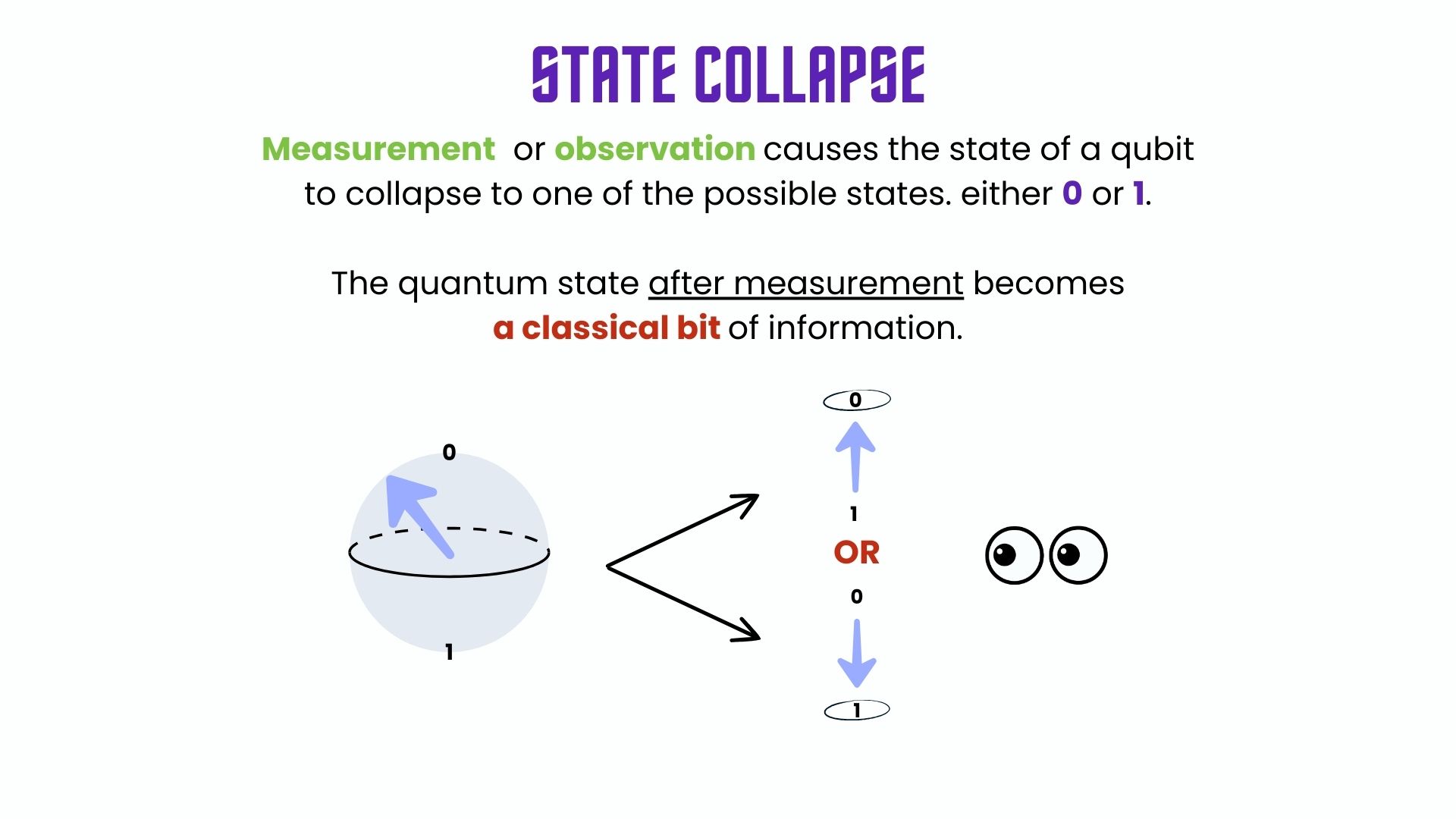
Whilst it is in the box, it can be in a superposition of being in the alive state or the dead state. However, you decide to open the box, and find that the cat is dead. You make another quantum cat in a similar way, and open to find that this cat is alive.
This is called wave-function collapse. The act of observing the quantum cat is actually a measurement. Measurements disturb quantum systems, causing them to lose their quantumness.
How might we describe the state of the cat when it was in the box, based on our observations? 🧠
Answer
We’d need to count and take statistics on the number of times we see the cat alive versus the opposite outcome.
The truth is that the higher dimensional state of the qubit collapses into a classical state once we observe it. In order to describe the state of the qubit before collapse, we must have multiple qubits prepared in the same way, make multiple observations, and take statistics of those observations in order to recover the qubit state prior to collapse.
Here, the numbers \(c_0\) and \(c_1\) are related to the probabilities for observing that state.
How might the state of a qudit or quantum dit be represented? 🧠
Answer
A qubit can only collapse onto 1 of 2 possible states. A qudit can collapse onto 1 of d possible states.